
October 12, 2026 · 6-min read
Baptism Invitation Wording: Examples and Details to Include
A few thoughtful words can help the people you love feel welcome on a meaningful day.
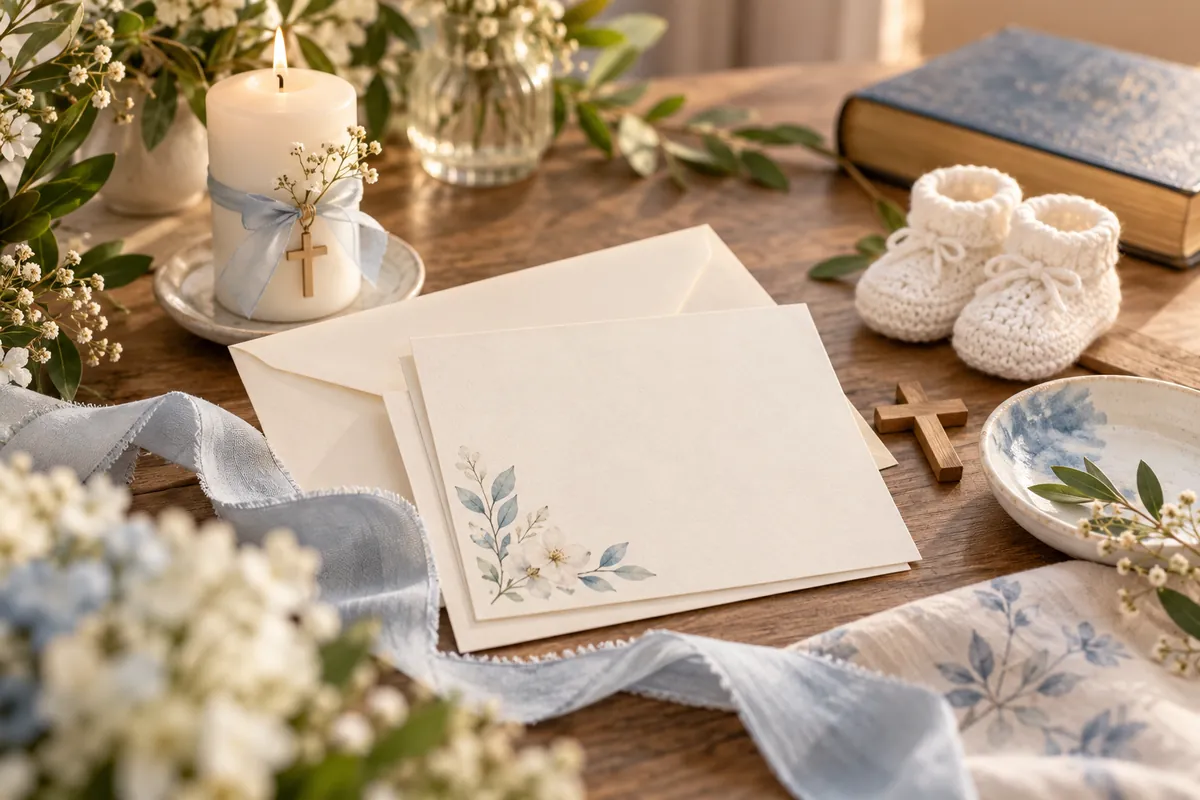
Baptism invitation wording should say who is being baptized, when and where the ceremony takes place, whether a reception follows, and how guests should RSVP. A simple opening such as “Please join us for the baptism of [name]” gives you a warm, clear starting point.
You do not need elaborate language to show how much the day means. A personal welcome and practical details help family and friends arrive ready to share it with you.
What should a baptism invitation include?
Before choosing the wording, confirm the ceremony arrangements with your church. If the baptism takes place during a regular worship service, guests need the service start time.
Use this checklist as you draft:
- The person’s name: Use the name you want guests to see, including a middle name if meaningful.
- The occasion: State that you are inviting guests to a baptism or christening.
- The date: Include the day of the week, month, day, and year.
- The time: Label the ceremony or worship service start time clearly.
- The church: Give its full name and street address, including the city.
- The reception: Say whether a gathering follows and provide its location.
- The RSVP: Include a reply deadline, contact name, and phone number or email.
- Helpful guidance: Add any confirmed arrival, parking, or accessibility details guests need.
Parents’ names, godparents’ names, and a short expression of faith are optional. Keep the essential information easy to find, especially if you are working with a small printed card.
What baptism invitation wording can I copy?
Choose the example that sounds most like your family, then replace every bracketed detail. Each version can work for a printed invitation, an email, or a message.
Simple and warm
Please join us for the baptism of
[Child’s full name]
[Day of week, month, day, year] at [time]
[Church name]
[Street address, city, state]We would love to share this special day with you.
Please join us for [lunch/light refreshments] afterward at
[Reception location and address].Please RSVP to [name] by [date] at [contact details].
This is a useful choice when you want the invitation to feel personal without adding much text.
Traditional and formal
[Parent or host names]
invite you to attend the baptism of
[Child’s full name]
on [day of week, month, day, year]
at [time].[Church name]
[Street address, city, state]A reception will follow at
[Venue name and address].Kindly reply by [date] to [name] at [contact details].
Use the host line that reflects your family. One parent’s name, two parents’ names, or “The [surname] family” can all be clear and welcoming.
Gently faith-centered
With grateful hearts, we invite you to celebrate
the baptism of [child’s full name].Please join us in prayer and thanksgiving on
[Day of week, month, day, year] at [time].
[Church name and full address]We will gather for [refreshments/lunch] afterward at
[Reception location and address].Please RSVP by [date] to [name] at [contact details].
A short phrase of gratitude is enough. You do not need to explain your family’s beliefs or include a Scripture passage for the invitation to express faith.

Can I use christening instead of baptism?
Use the term your church and family use for the occasion. Some families use “christening” for a baby’s baptism, while terminology and practices vary between churches.
If you are unsure, ask the person arranging the service before printing. You can adapt any example above by changing the opening:
We warmly invite you to the christening of
[Child’s full name].
Keep the remaining ceremony, reception, and RSVP details the same. Guests need a clear invitation more than a lengthy explanation of terminology.
How do I word the reception details?
Say exactly what you are inviting guests to attend. “Reception to follow” is brief, but naming the location and type of gathering makes planning easier.
Choose a line that matches your arrangements:
- At the church: “Please join us for cake and coffee in the church hall after the service.”
- At home: “Lunch will follow at our home: [full address].”
- At a separate venue: “Please join us for lunch at [venue and address] beginning at [time].”
- Ceremony only: “Please join us for the baptism ceremony. There will be no reception afterward.”
If the reception has a fixed start time, include it. If it begins when the service ends, “after the service” may be clearer than estimating a time you have not confirmed.
For a small private ceremony followed by a larger gathering, make the invitation’s scope explicit:
Following a private baptism ceremony, we would love you to join us for lunch celebrating [name] at [location] on [date] at [time].
What should the RSVP line say?
Give guests one clear action, a deadline, and a person to contact. Avoid “RSVP to Mom,” which may be confusing when invitations reach extended family or friends.
For a straightforward reply, use:
Please RSVP by [date] to [full name] at [phone number or email].
If you need a meal count, add:
Please let us know how many adults and children will attend lunch, along with any dietary requirements.
If guests can attend either part of the day, ask them to specify:
When you reply, please let us know whether you will join us for the ceremony, lunch, or both.
Address the invitation to everyone invited. Naming a couple and their children helps avoid uncertainty about whether the whole household is included.

How can I help guests feel comfortable?
Some loved ones may be attending a baptism for the first time. A brief, practical note can help them feel welcome without filling the invitation with instructions.
Include only details you have confirmed with the church, such as:
- “The baptism will take place during the [time] worship service.”
- “Please arrive [number] minutes before the service begins.”
- “Step-free access is available through [entrance].”
Longer guidance can go in a follow-up message. If guests ask what they should bring, you can share this guide to what to bring to a baptism besides a gift.
What should I check before sending invitations?
Read the finished invitation as though you have never visited either location. Could you find the church, know when to arrive, and reply without asking another question?
Before sending, check:
- Names, spelling, and all replaced placeholders.
- The date and matching day of the week.
- Ceremony and reception times, including a.m. or p.m.
- Complete addresses for both locations.
- The RSVP contact details and deadline.
- Text size and readability on the printed card or phone screen.
If you would like a printable starting point, the “You’re Invited to Celebrate a Baptism” invitation is a gentle option to consider once your details are settled.
Choose words you would comfortably say to someone you love. “We would love to share this day with you” can carry all the warmth your invitation needs.
Frequently asked questions
- How far in advance should you send baptism invitations?
- Four to six weeks ahead is a useful planning window for a local gathering. Give earlier notice to guests who need to travel, and confirm the church arrangements before sending invitations.
- Do godparents' names go on baptism invitations?
- Including godparents' names is optional. You can add a short line recognizing them if you wish, but their names are not needed for guests to understand the invitation.
- Is it okay to send baptism invitations by text?
- Yes, a text invitation can work well for a small gathering. Include the ceremony location, date, time, reception plans, and a clear way to RSVP, just as you would on a printed invitation.
- Should a baptism invitation mention gifts?
- You can leave gifts off the invitation entirely. If you want to reassure guests, a brief line such as 'No gifts, please; we are grateful to celebrate with you' is enough.
- baptism
- baptism invitations
- baptism planning
- christening
- invitation wording
Related reading
- What to Say When Someone Thanks You for Their Baptism GiftHow to respond when someone thanks you for a baptism gift, with simple wording for cards, texts, calls, and social media.
- What to Give a New Godmother or Godfather (Not the Baby)A clear guide to choosing a gift for godmother or godfather at baptism, with ideas, budget guidance, and card wording.
- What to Bring to a Baptism (Besides a Gift)What to bring to a baptism beyond the gift: a card, a camera, small cash for a reception, and a little grace for a long church morning.